
10 Book Marketing Ideas That Help Authors Reach More Readers in 2026
Writing a book is a process of time, heart and hard work. But writing your book is merely the beginning. Now you have to help
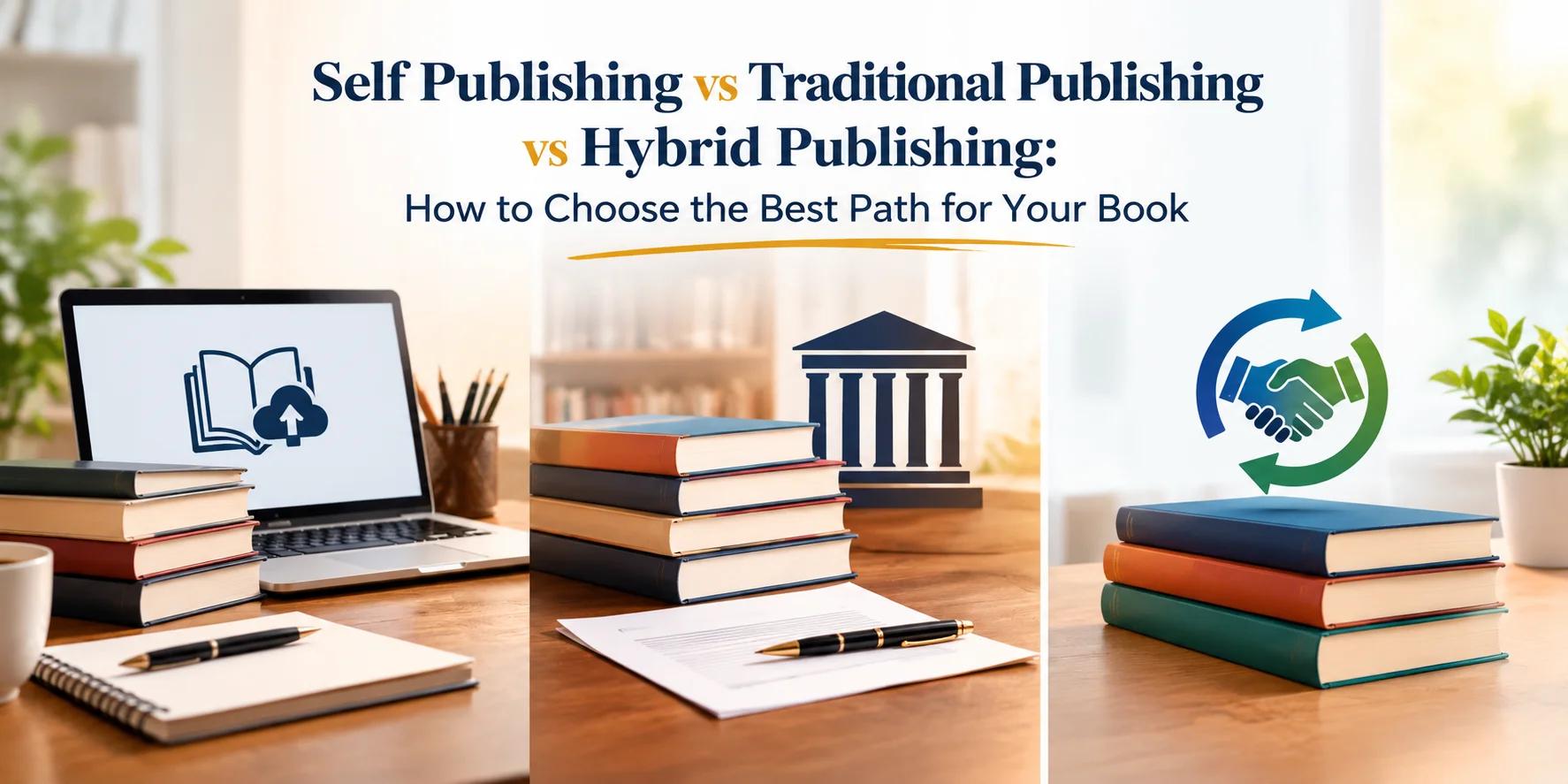
You have finished writing your book. Now comes a choice that could shape its future.
Should you publish it yourself, find a publisher, or choose a path between the two?
The debate over self publishing vs. traditional publishing can feel confusing. In fact, both paths offer real benefits. However, neither works for every author. There’s another option, too: hybrid publication, although this brings new questions as well.
Ultimately, the ideal method will depend on your budget, goals and how much control you want.
So before you decide, let’s look at how each publication model works.
Every author wants readers to discover their book. However, the road to publication can look very different.
For example, some authors want complete control. Others prefer a publisher to guide the process. Meanwhile, some want expert help without following the traditional route.
That’s why three basic models of publishing come in.
You have all the control over publishing your book.
You pick the cover, you set the pricing and you determine when to debut. In addition, when needed, you also hire editors, designers and others.
For example, authors can self-publish ebooks and print books directly on platforms like Amazon Kindle Direct Publishing.
However, freedom comes with work. You must manage production, quality, and promotion.
Still, many authors enjoy making every key decision themselves.
It works through a publishing house.
You submit your novel, normally through a literary agent. When a publisher buys it, the firm often pays for the production.
Next, the crew edits, designs covers, prints and distributes. In addition, the publisher may also plan PR and marketing.
In return, you give up some publishing rights, and you get royalties as set out in your contract.
However, acceptance can be hard. The process may also take considerable time.
It combines parts of the other two models.
In this model, authors help fund publication, while the publisher manages agreed publishing tasks.
A good hybrid publisher will assess submissions and have defined quality criteria. Furthermore, it also provides a contract describing rights, services, fees and royalties.
But not all paid publishers are hybrids.
The Independent Book Publishers Association explains the standards reputable hybrid publishers should meet.
So, always check the company’s publishing model before paying.
The biggest difference goes beyond who prints your book.
In fact, it affects your money, rights, time, and role in each decision.
Here’s how the three paths compare.
|
Feature |
Self-Publishing |
Traditional Publishing |
Hybrid Publishing |
|
Upfront costs |
Usually paid by author |
Usually funded by publisher |
Shared or author-funded |
|
Creative control |
High |
Shared with publisher |
Depends on contract |
|
Publishing speed |
Often faster |
Often slower |
Varies by company |
|
Royalties |
Platform-based |
Contract-based |
Contract-based |
|
Marketing |
Mainly author-led |
Shared responsibilities |
Depends on package |
|
Selection process |
No publisher approval |
Competitive |
Should involve review |
|
Publishing rights |
Usually retained |
Certain rights licensed or assigned |
Depends on contract |
These differences matter since publishing isn’t just about getting your first book out there.
For example, a contract can affect future editions, translations and audiobook possibilities.
So think about your long-term plans before you start writing.
Imagine illustrating a children’s book, with vibrant, lively imagery.
You know exactly how each page should look. You also want the book ready for an upcoming school event.
Therefore, self-publishing could suit that goal.
One of the greatest benefits of self publishing is creative freedom.
For instance, you can choose your title, artwork, layout, and release date.
Also, you can update your book whenever you want to. You don’t have to get permission for every change.
Traditional publishing typically has significant review and production periods.
As a result, self-publishing is faster after you have your text and files available.
But don’t rush the procedure. A fast release means little if readers detect mistakes.
You decide how much to spend on editing, design, and promotion.
For example, some authors work with small budgets. Meanwhile, others invest in full production teams.
You can also choose which tasks to handle yourself.
The main drawback?
You must make sure every part of your book meets reader expectations.
Moreover, reaching readers takes ongoing work. Publishing a book doesn’t mean buyers will find it.
Now let’s say you have authored a book that has wide market appeal.
You want bookstore exposure, an established editorial team, and professional guidance.
As a result, traditional publishing may offer those benefits.
The benefits of traditional publishing often begin with its expert team.
For example, editors help improve your manuscript. Designers create a market-ready cover. Production teams prepare the final book.
In addition, publishers may have established sales and distribution networks.
A traditional publisher generally pays to produce your book.
In some cases, contracts also include an advance against future royalties.
However, advances aren’t guaranteed, and their size varies.
Existing publishers are likely to have contacts with retailers and distributors.
As a result, that could give their books a better shot at physical outlets.
Of course, a book deal doesn’t mean big sales or shelf space.
The biggest downside?
You may wait months to find an agent or publisher. Many manuscripts never receive an offer.
Plus, the publisher usually has a strong voice in decisions about your book.
What if you want publishing support but don’t want to pursue literary agents?
Hybrid publishing may seem like an appealing middle ground.
For example, a memoir writer may need editing, design, and print support. Yet they may also want input on the final cover.
As a result, a suitable hybrid publisher could provide a managed process.
However, the details matter.
For instance, some companies offer strong editorial care and clear distribution plans. Others provide little beyond basic file preparation.
Therefore, ask exactly what your payment covers.
Check whether the publisher selects manuscripts, uses its own imprint, and provides real distribution services.
Also, review royalty terms and how you can regain rights.
A higher price doesn’t always mean better service.
Most importantly, paying for publication doesn’t guarantee sales, reviews, or bookstore placement.
Ultimately, your definition of success will determine the best choice.
For some authors, success is having their book in stores.
Some see it as a way to tell a family story; others as a way to build an independent career as a writer.
You want full creative control and a flexible schedule for your releases.
You also like managing a budget and recruiting expertise.
For example, this route may suit authors who already know their readers.
You want an established publisher to fund production.
You’re also willing to submit your manuscript and wait for a decision.
In particular, this path may suit authors seeking established trade distribution.
You can fund publication and want a publisher-led process.
But be sure the company is professionally accredited.
Furthermore, you should also know exactly what rights and services come with your contract.
No single path guarantees success. The right choice supports your goals without creating risks you can’t manage.
Before choosing any publishing partner, ask these questions:
Also read the whole contract before you agree to it. If you are in doubt about anything, seek independent advice.
As a result, these methods can help you prevent costly surprises.
Choosing a publishing path should feel like a smart decision, not a gamble.
After all, each model has value. However, your goals should guide the choice.
Thinking of self-publishing but need help with production? You don’t have to do it all on your own.
WestBow Publishers provides professional book publishing services to assist authors in developing and publishing their works.
The focus is on creating a professional finished book, from editing to book design to publishing assistance.
But before you take the next step, think about what your project really requires in terms of assistance.
Finally, then pick a road that fits your story, budget and future ambitions.
Get professional help to turn your finished work into a professionally published book.
Depends on what you want to do. Self-publishing gives you more control and more flexibility. Traditional publishing is paid production and existing distribution. Choose based on your wallet and priorities.
Yes. But publication is not enough. Good editing, good design, clear positioning and consistent promotion all enable readers to find your book.
When the company actually provides publishing value. Before investing, check its editing standards, distribution plans, fees, royalties and contract.
Yes. You can get support for editing, cover design, formatting and production. This means you can oversee your publication journey without having to do it all yourself.
Start with a comprehensive text and a clear aim for publishing. Then analyze your options, organize your budget and select solid production support before you release your book.
Recent Posts
Writing a book is a process of time, heart and hard work. But writing your book is merely the beginning. Now you have to help
You have finished writing your book. Now comes a choice that could shape its future. Should you publish it yourself, find a publisher, or choose
It takes time, care, and purpose to write a book. But completing your manuscript is just the first step in the process. Readers still need